Edge Conditions in the NYC Pedestrian Plaza Program
part of Graduate Thesis | Spring 2026
-
Manhattan
Johnny Hartman Plaza
Montefiore Plaza
Plaza De Las Americas
Ruth Wittenberg Triangle
Bogardus Plaza
Malcom X PlazaBronx
Lou Gehrig Plaza
Roberto Clemente Plaza
Fordham Plaza
Bryan Park Plaza -
Edges
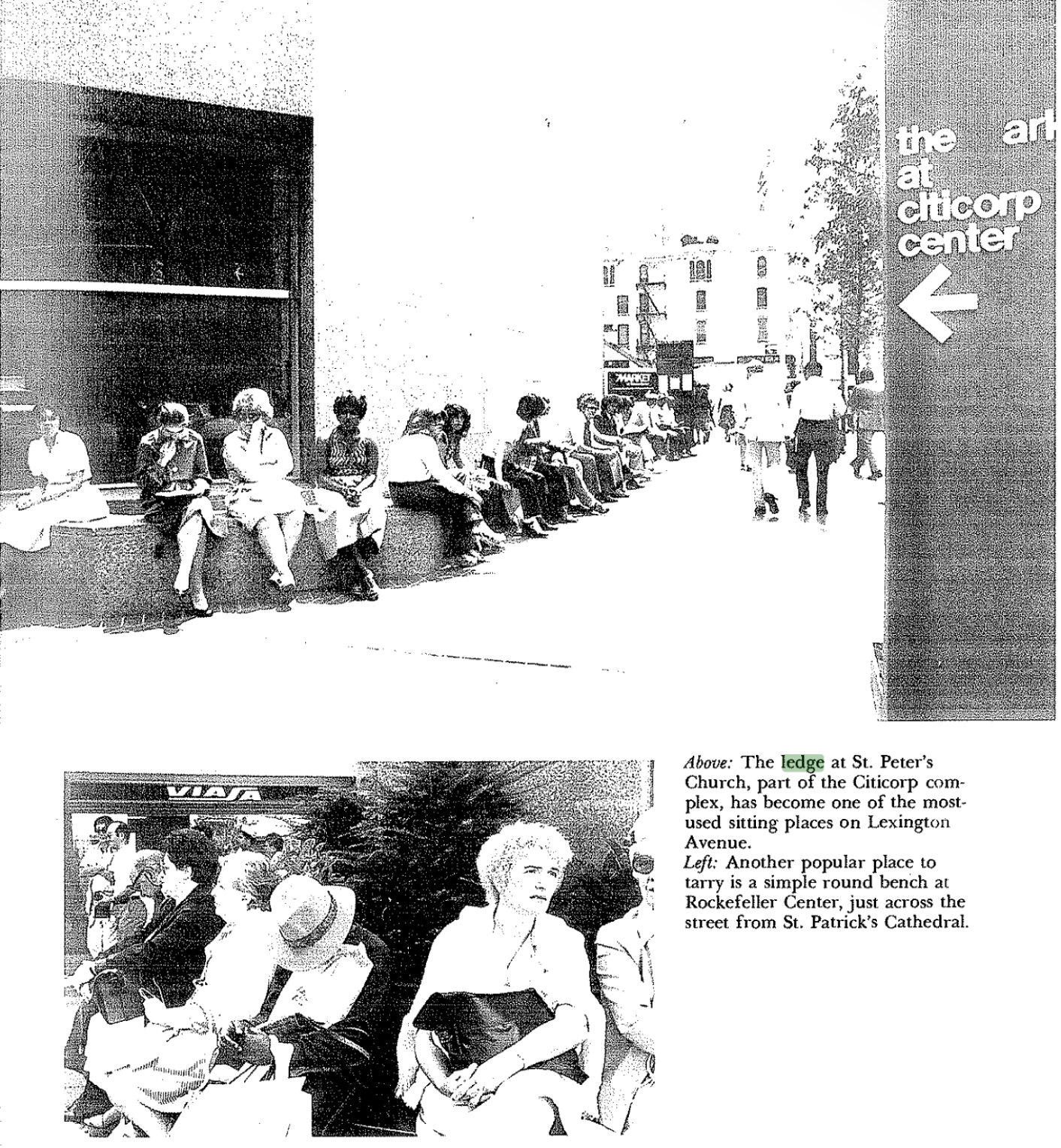
Public life happens at edges, not at centers. Gehl named the edge effect and observed that "events grow inward, from the edge toward the middle of public spaces." Whyte found in New York's corporate plazas that "it is the edges of sitting surface that do the work." Alexander put it: "If the edge fails, then the space never becomes lively." Sennett distinguished boundaries (cell walls, low exchange) from borders (cell membranes, porous and resistant at once).Indeterminacy
Merleau-Ponty describes the body as held in permanent oscillation between attraction to the richness of the world and an anxious warning against getting lost in it. What the body needs to live is neither pure closure (which suffocates) nor pure openness (which dissolves), but a structure that holds the two in productive relation: enough anchor that the body is not lost, enough opening that it is not sealed. -
City scale — Proximity-Informed Research+
A method extending chrono-urbanism by using time-distance as the lens to layer planning frameworks against the plaza program.
92 plazas, walking-radius polygons (5-min, 15-min) following pedestrian paths
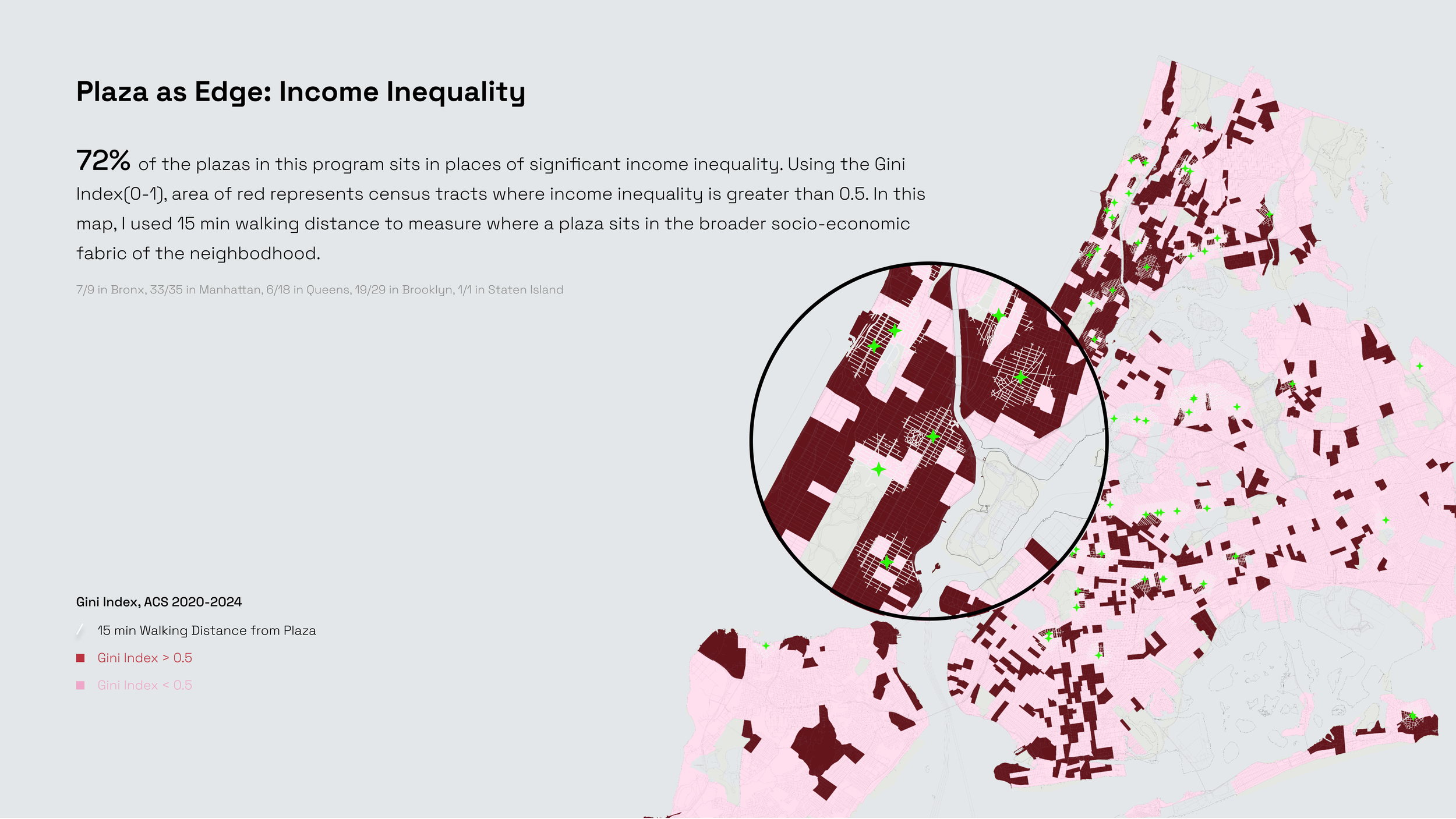
Layered against: zoning (MapPLUTO), income inequality (ACS Gini Index), partnership types (DOT records)
Body scale — Field observation
30-minute visits at 10 plazas during the ideal temperature and social time, Manhattan and the Bronx, weekday late afternoons 4–8 PM.
Pedestrian passing counts
Staying counts and locations
Activity patterns and objects brought or rearranged
Sketches and photographic records of built edges
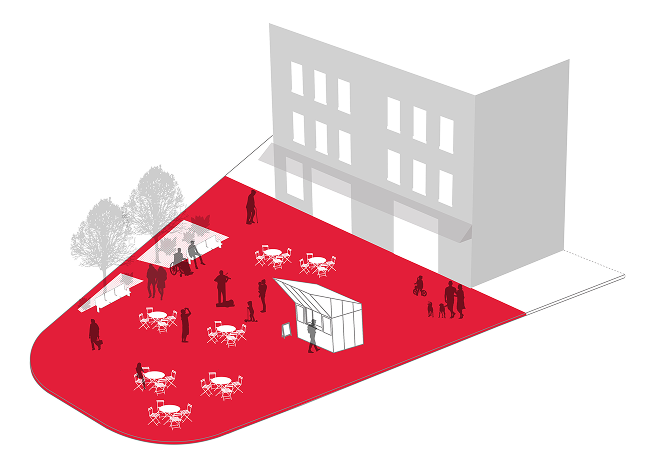
An area located fully within the public right-of-way that is designated by NYC DOT for use by pedestrians. The plaza may include amenities such as chairs, tables, umbrellas, greenery, and lighting. Generally, Plazas are maintained and managed by local partner organizations or other entities, such as BIDs or CBOs, referred to as a Plaza Partner.
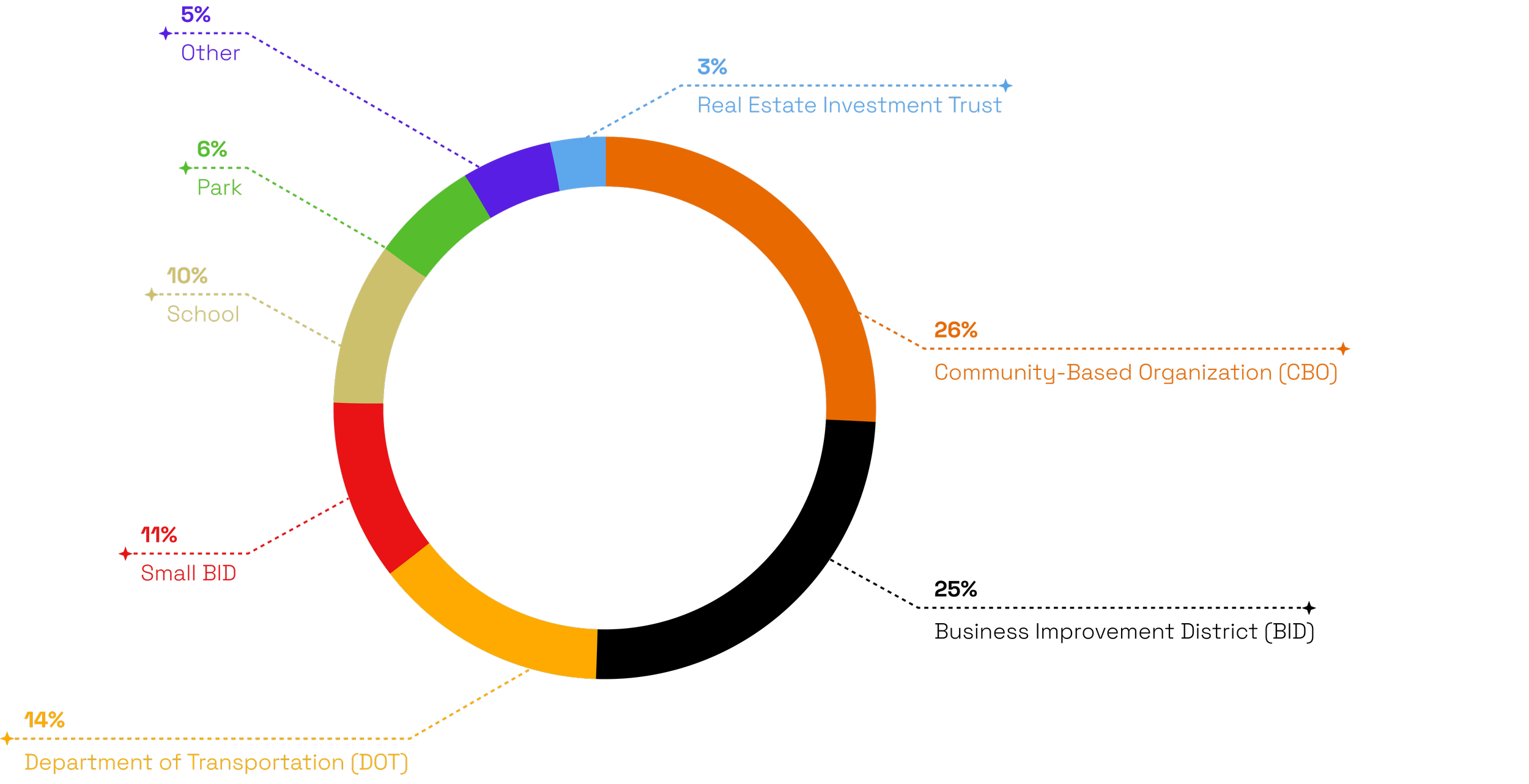
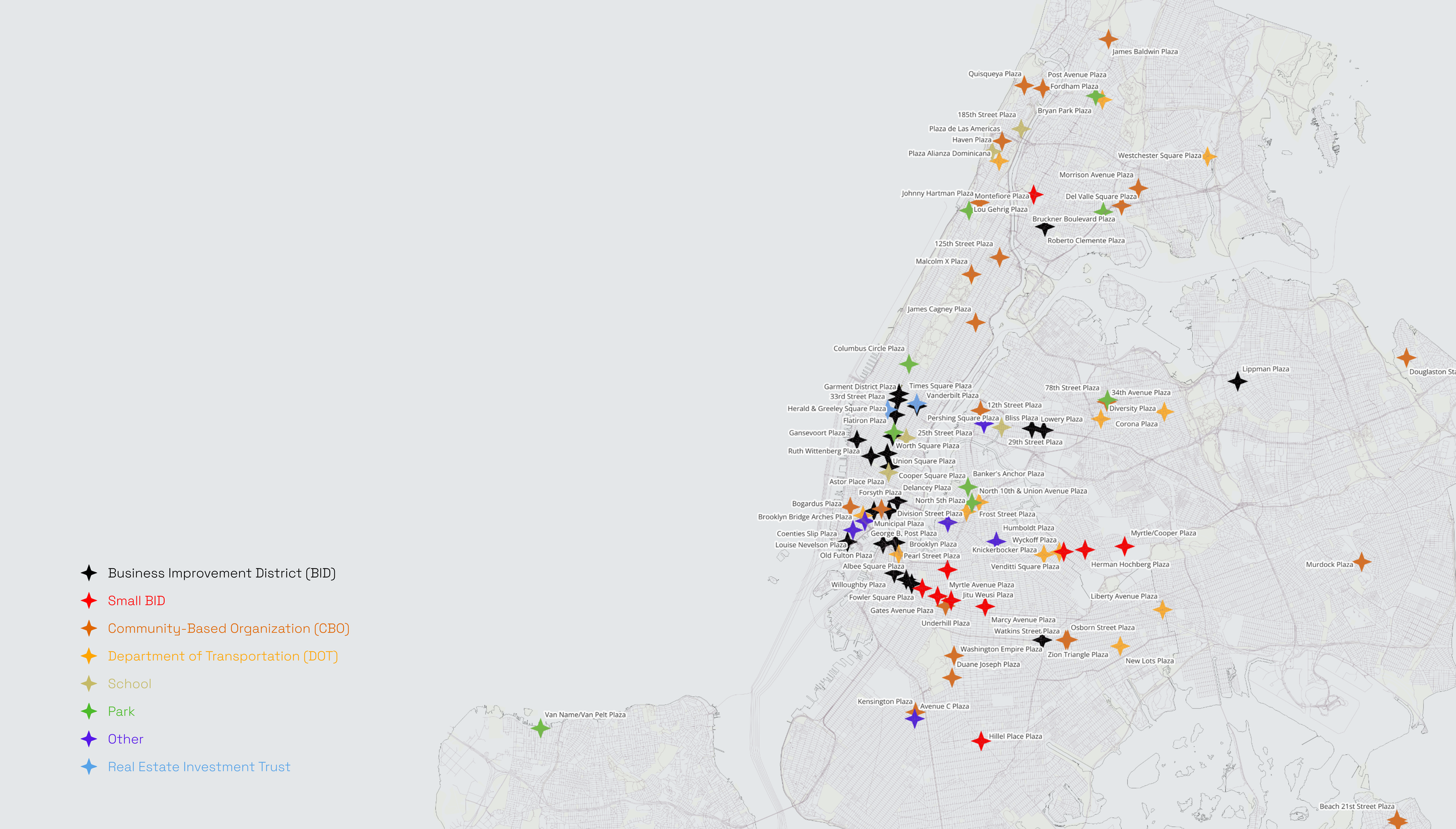
NYC DOT Pedestrian Plazas
Spatial Edge Configuration
Porous, Open, Nested
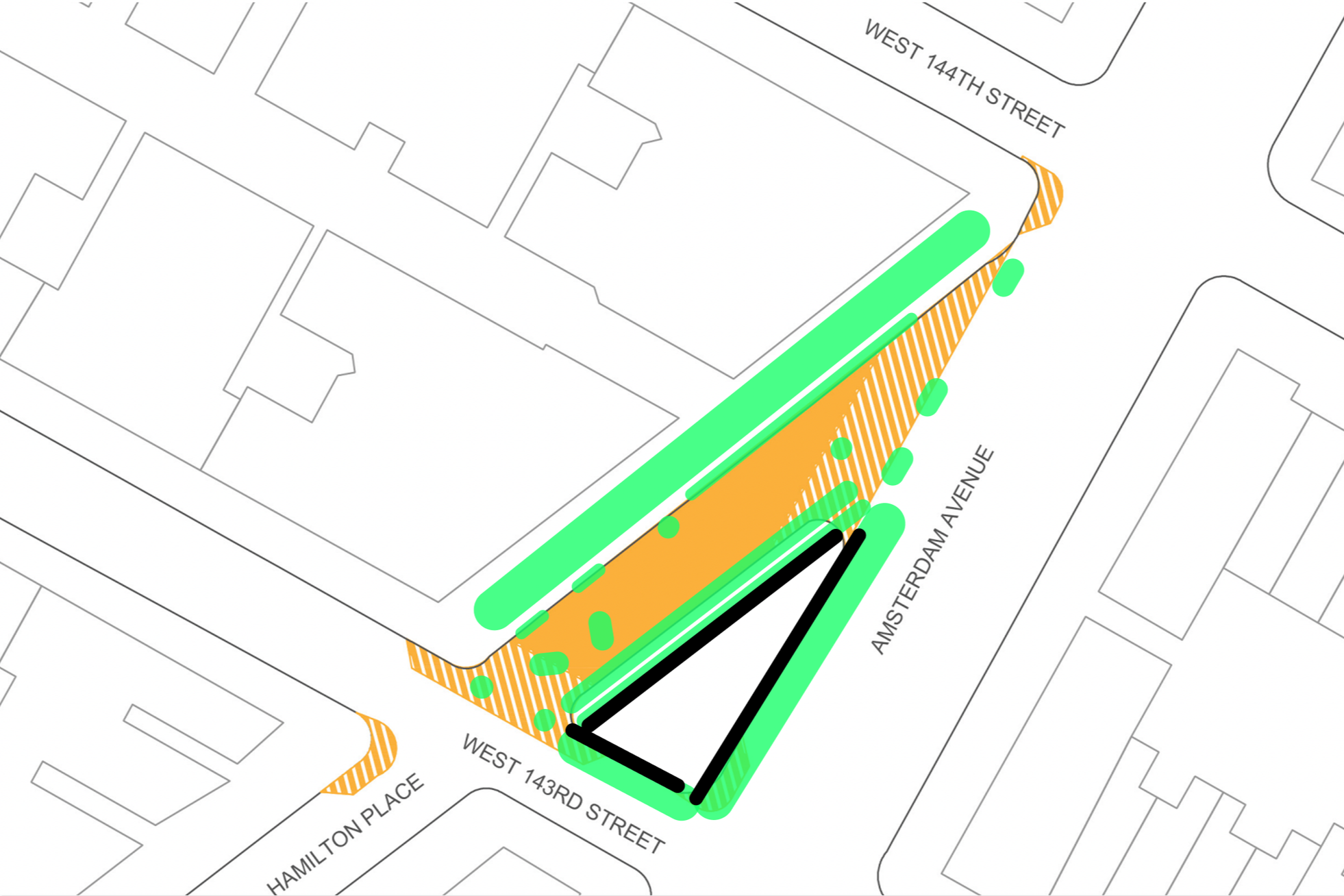
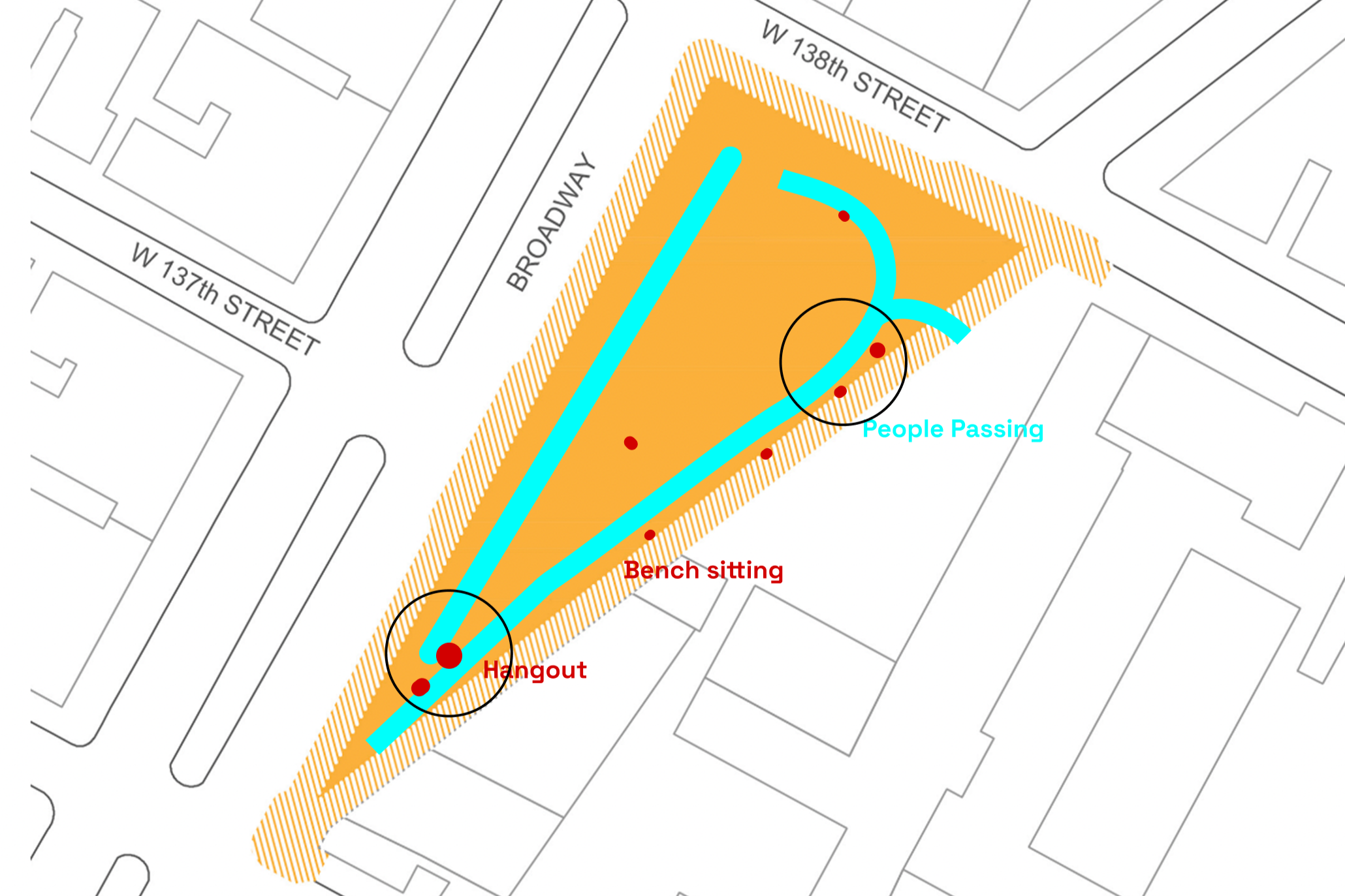
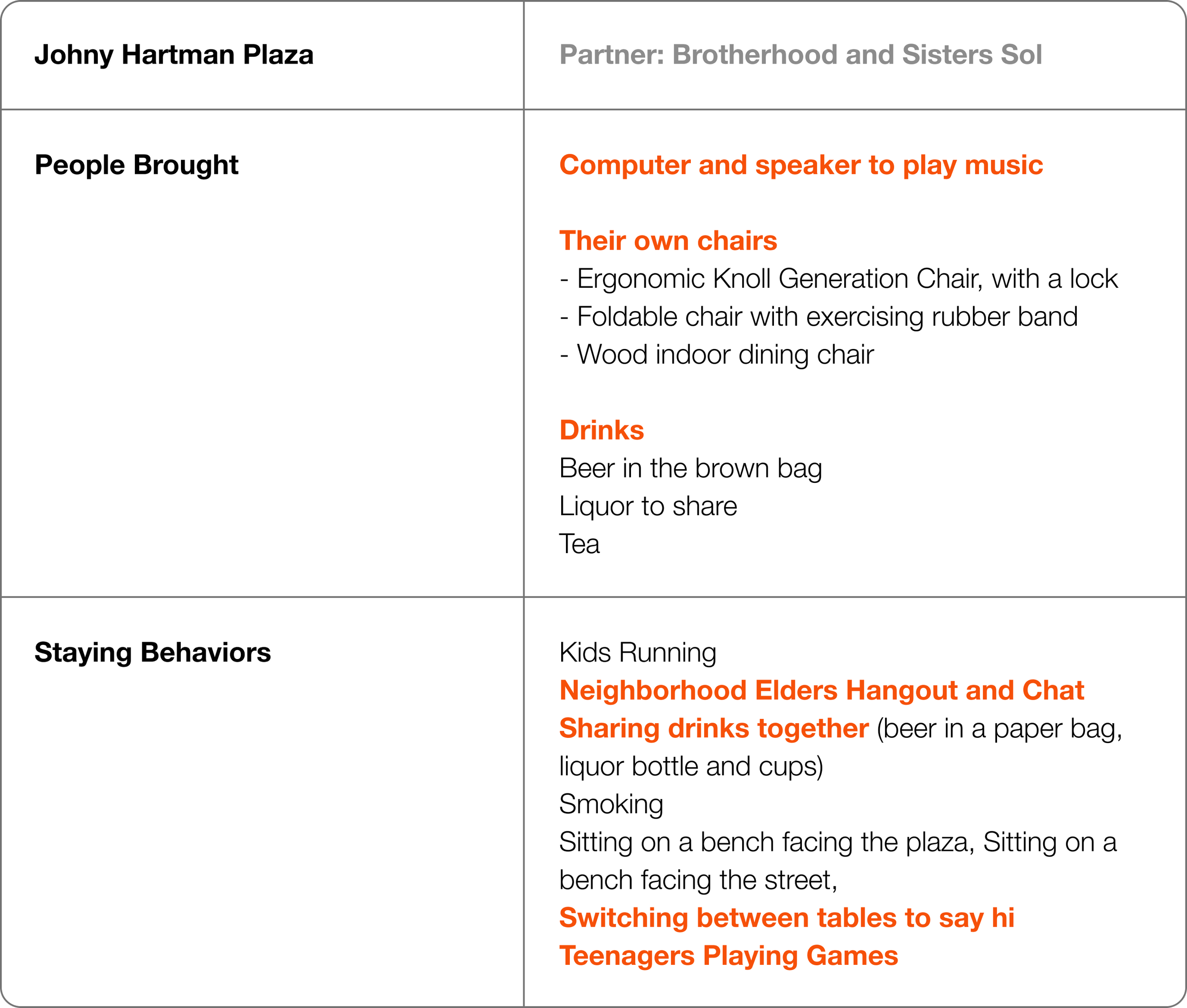
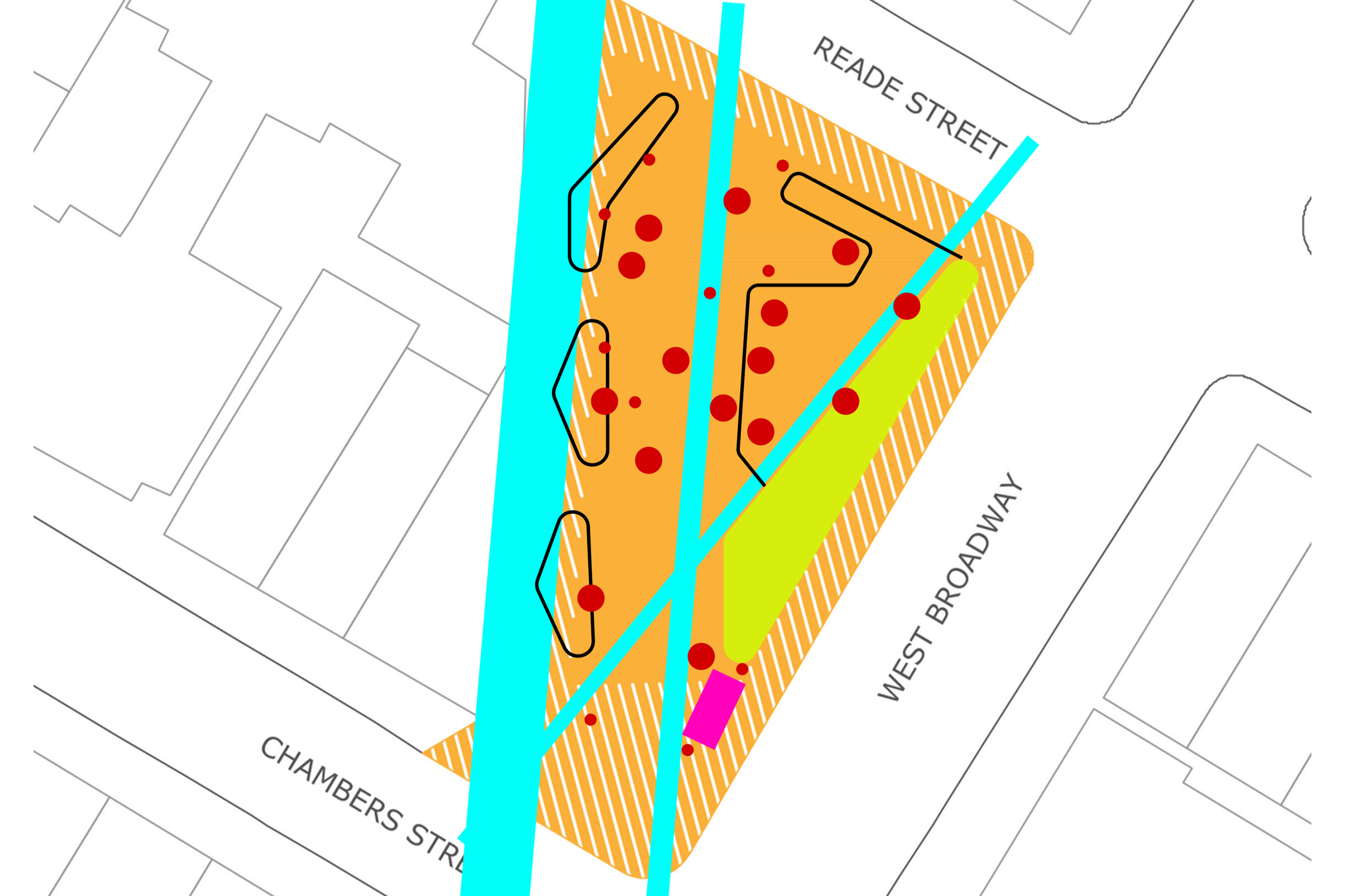
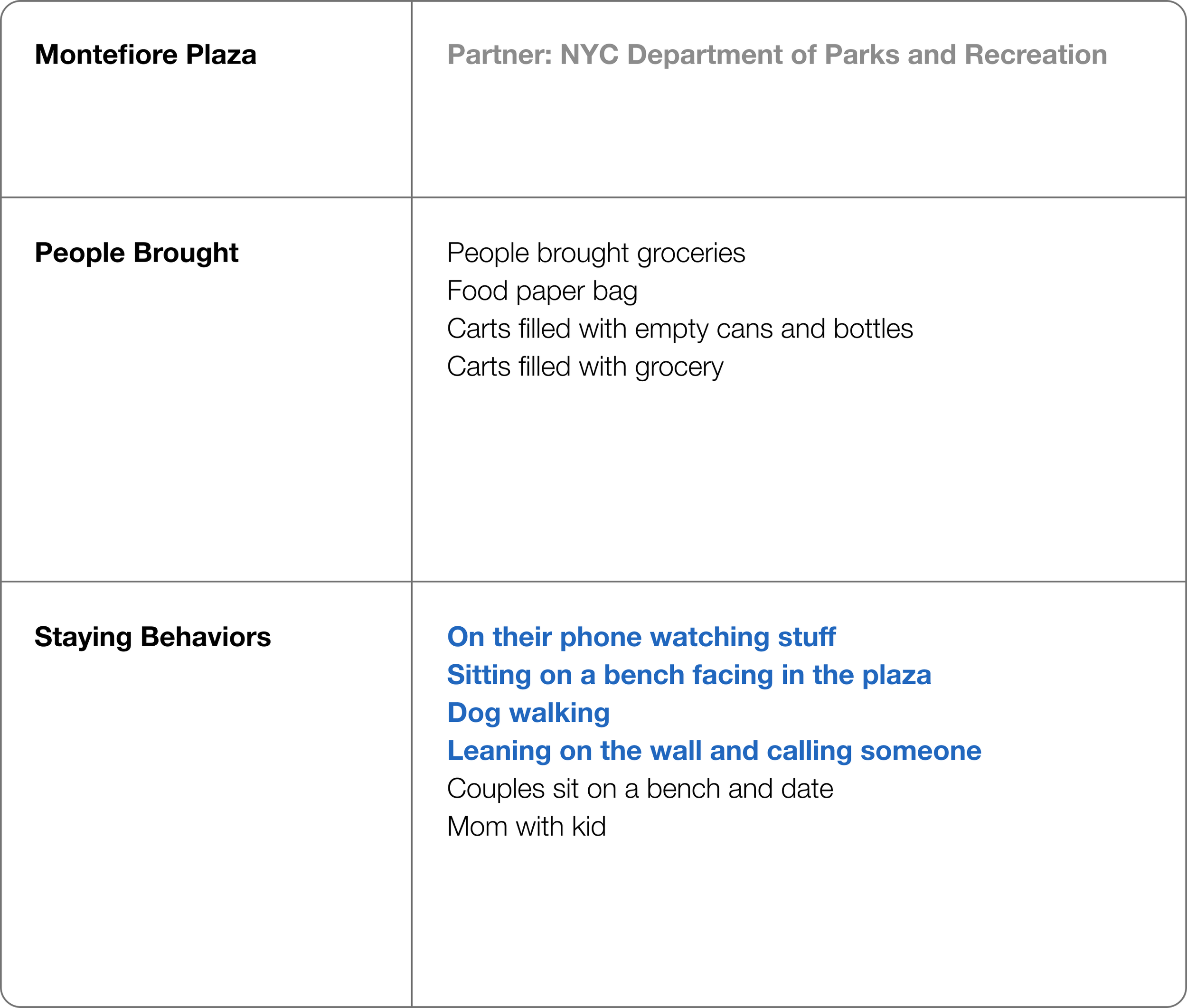
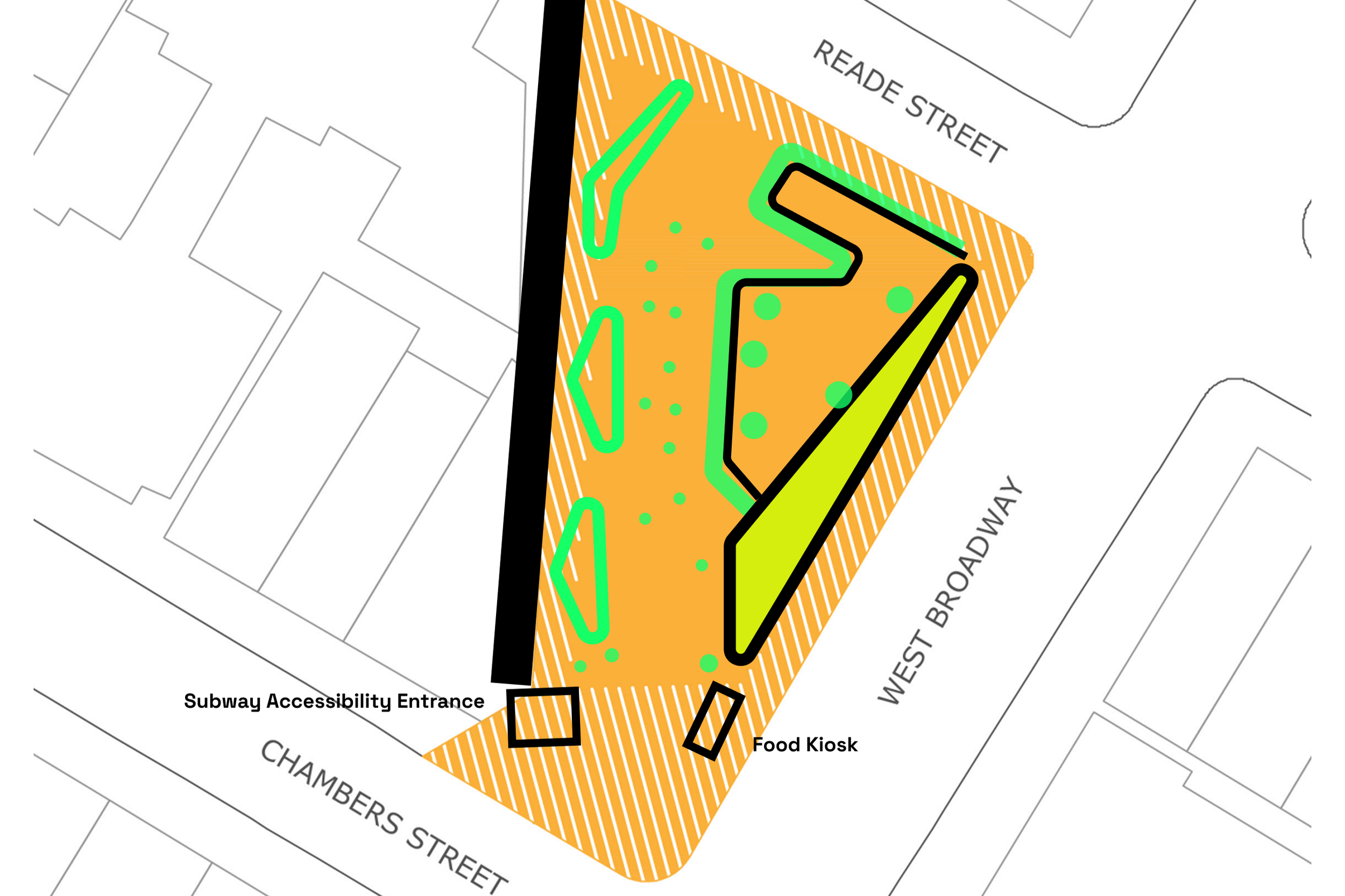
Public space observation of social activities in two adjacent plazas in Hamilton Heights, five min away from each other in the same neighborhood.
A Neighborhood Living Room
Johnny Hartman Plaza
Local Plaza Partner
Plaza Size
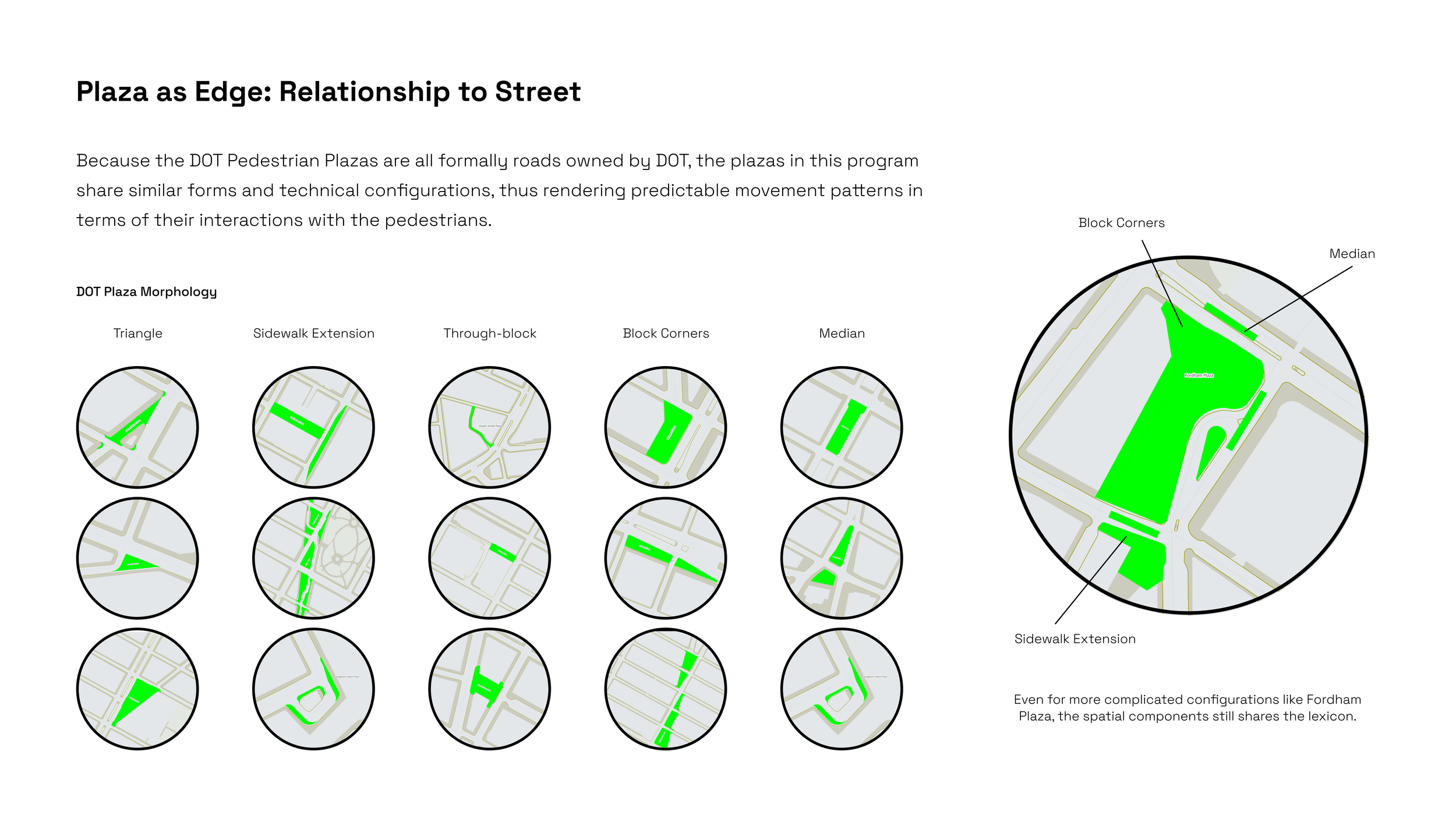
Plaza Geometry
The Brotherhood Sister Sol
6700 SF
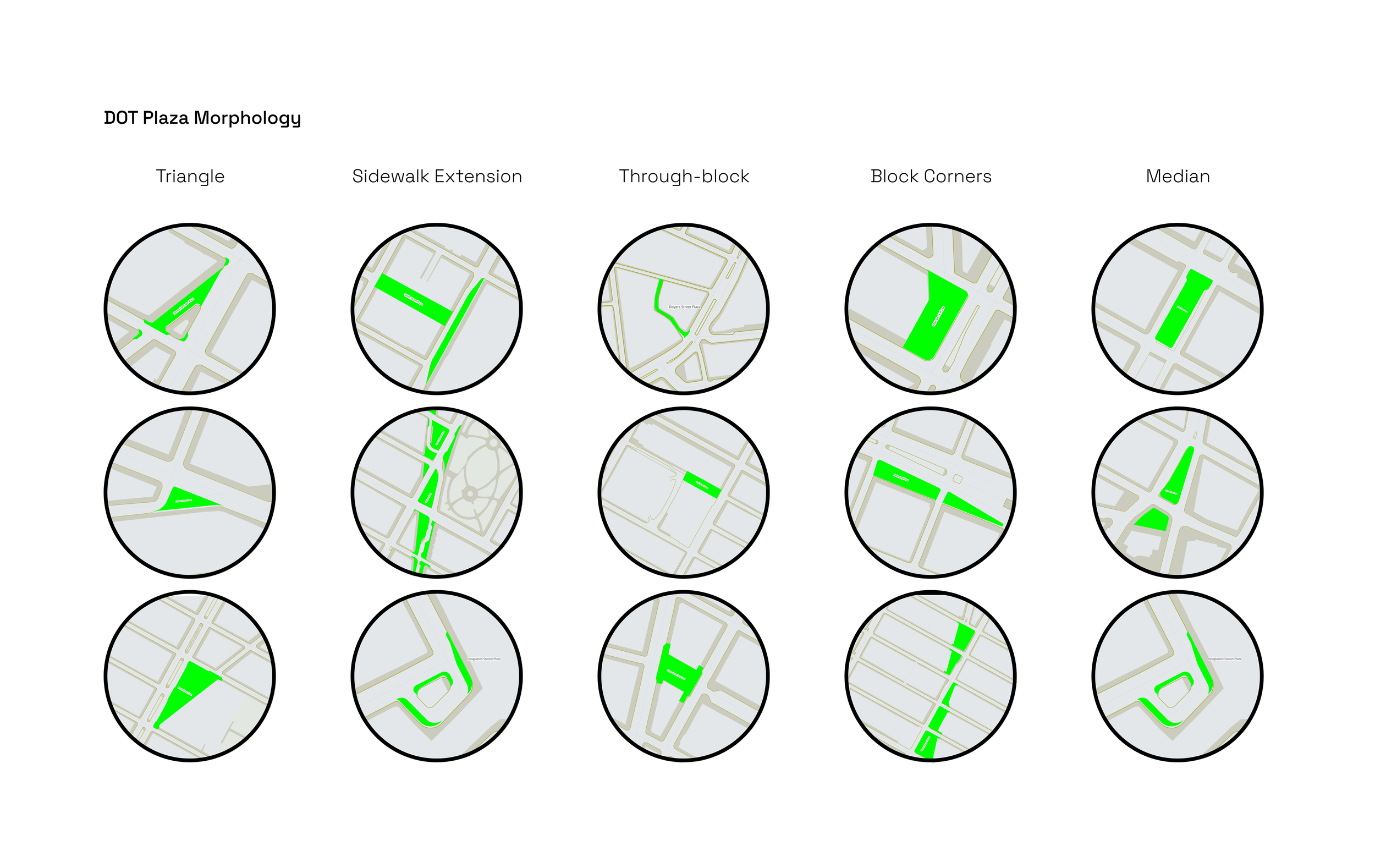
Triangle
Plaza Visit Record

Stay/Movement Diagram
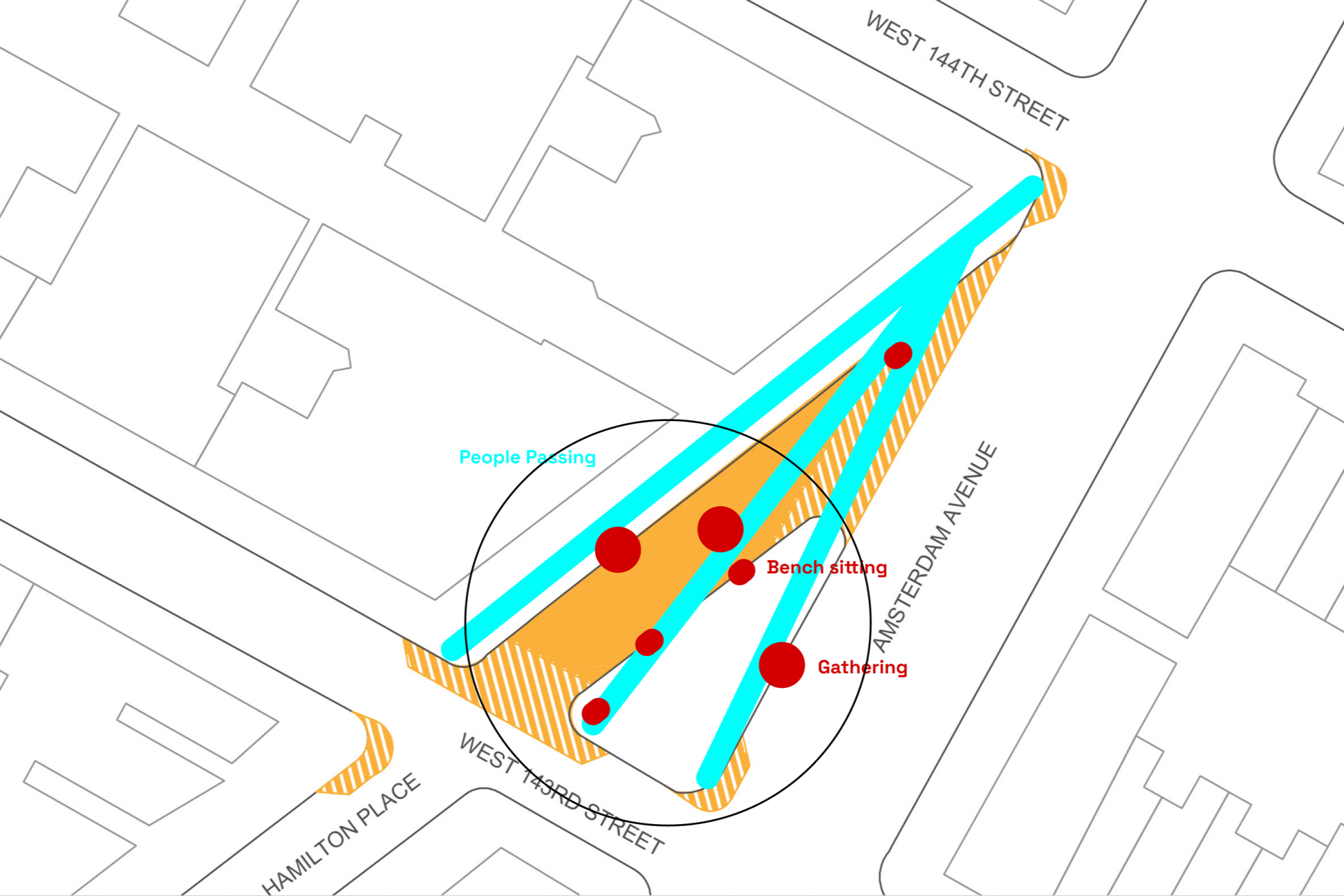
Staying Count Every 5 Minutes
Montefiore Plaza
Local Plaza Partner
Plaza Size
Plaza Geometry
NYC Department of Parks and Recreation
62100 SF
Triangle
With only a five-minute walk from each other, these two plazas feature distinctly different social activities on the observation day.
Passing
Staying
Social White Noise
Soft Edges
Hard Edges

Staying Behavior
Spatial Edge Configuration
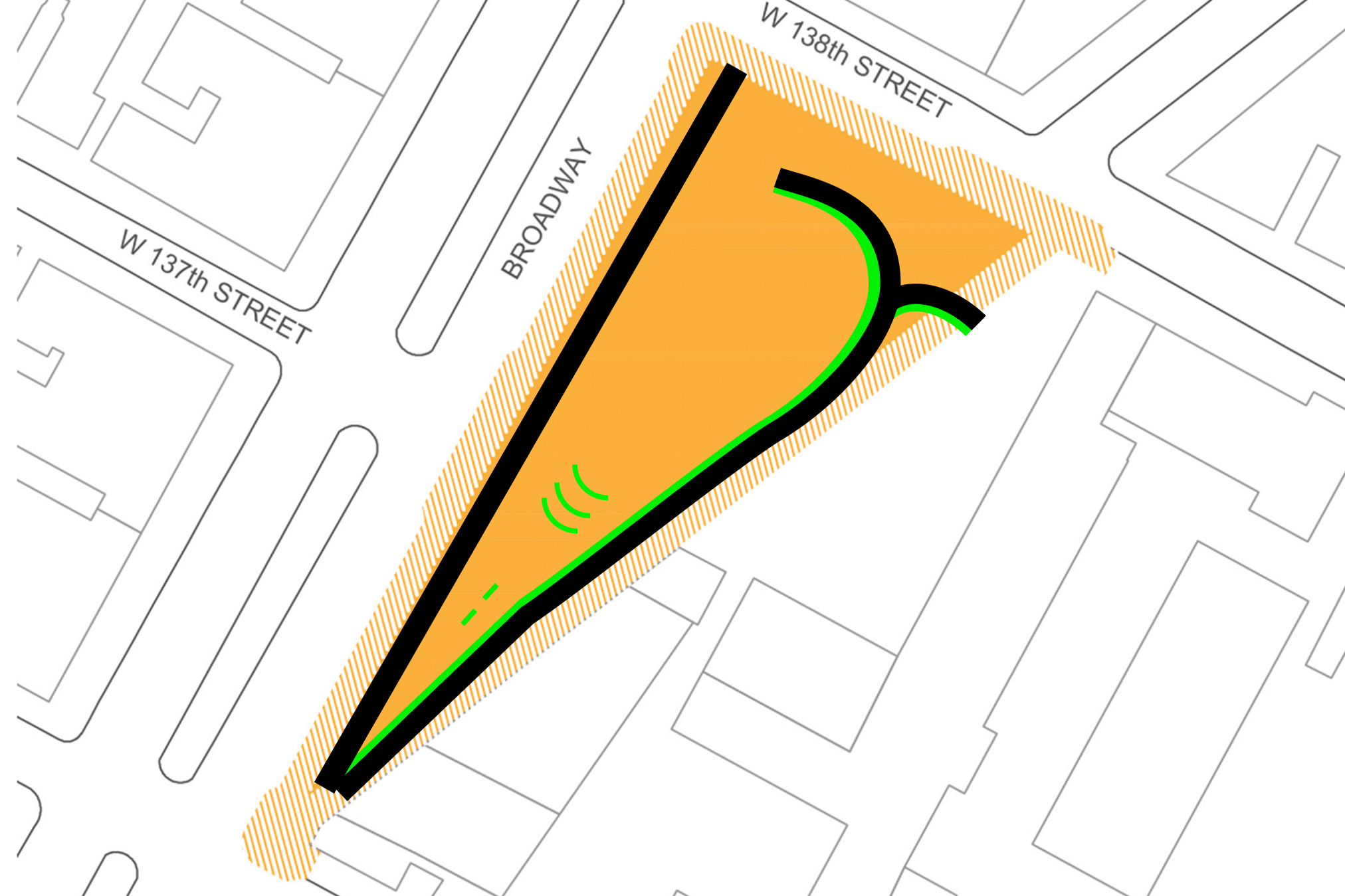
Staying Behavior
Passing
Staying
Social White Noise
Soft Edges
Hard Edges
A Local Social Hub
Bogardus Plaza
Local Plaza Partner
Plaza Size
Plaza Geometry
Friends of Bogardus Plaza
15800 SF
Block Corners
A Traffic Calming Park
Stay/Movement Diagram
Stay/Movement Diagram
Spatial Edge Configuration
Passing
Staying
Social White Noise
Soft Edges
Hard Edges
Urbanists on Edges
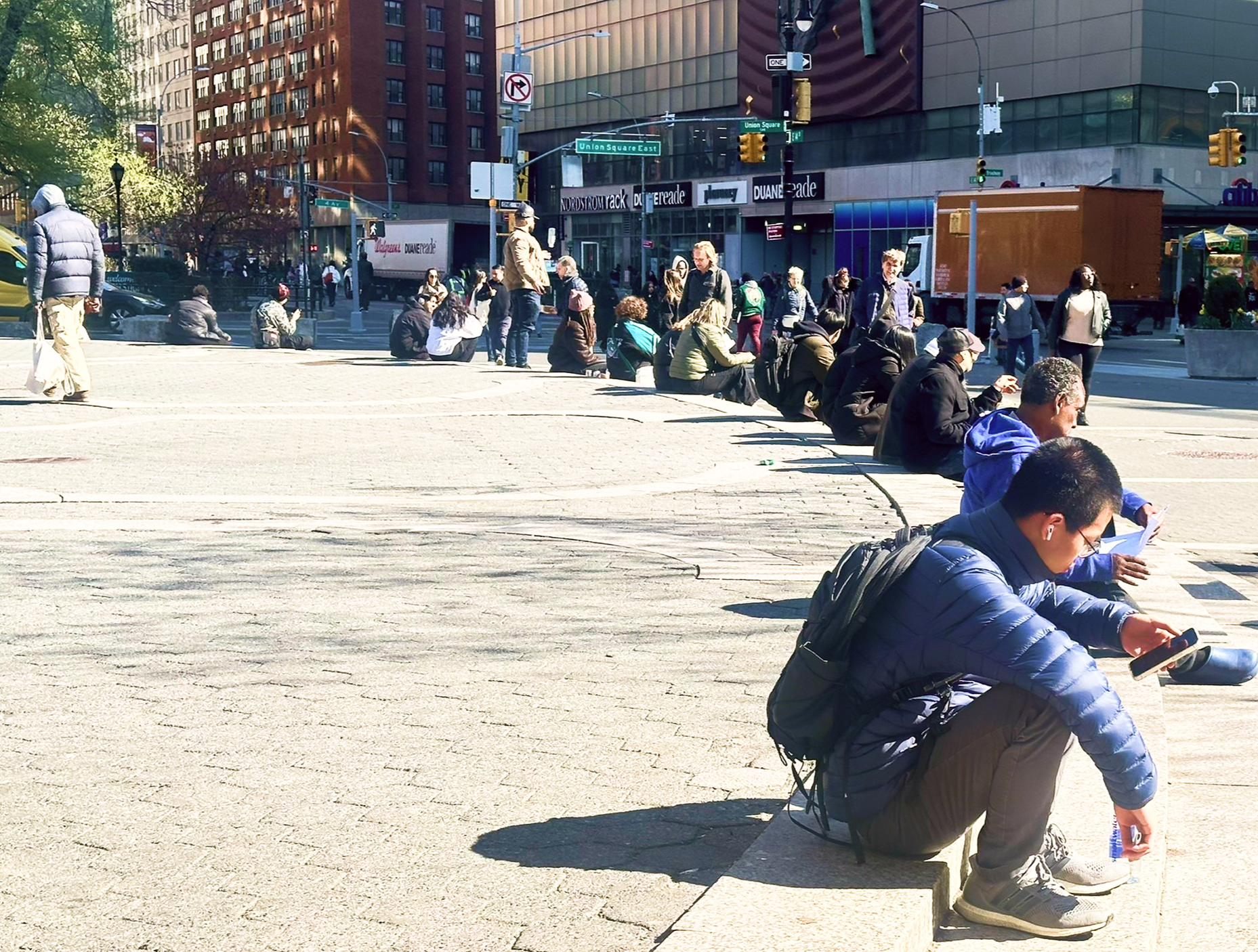
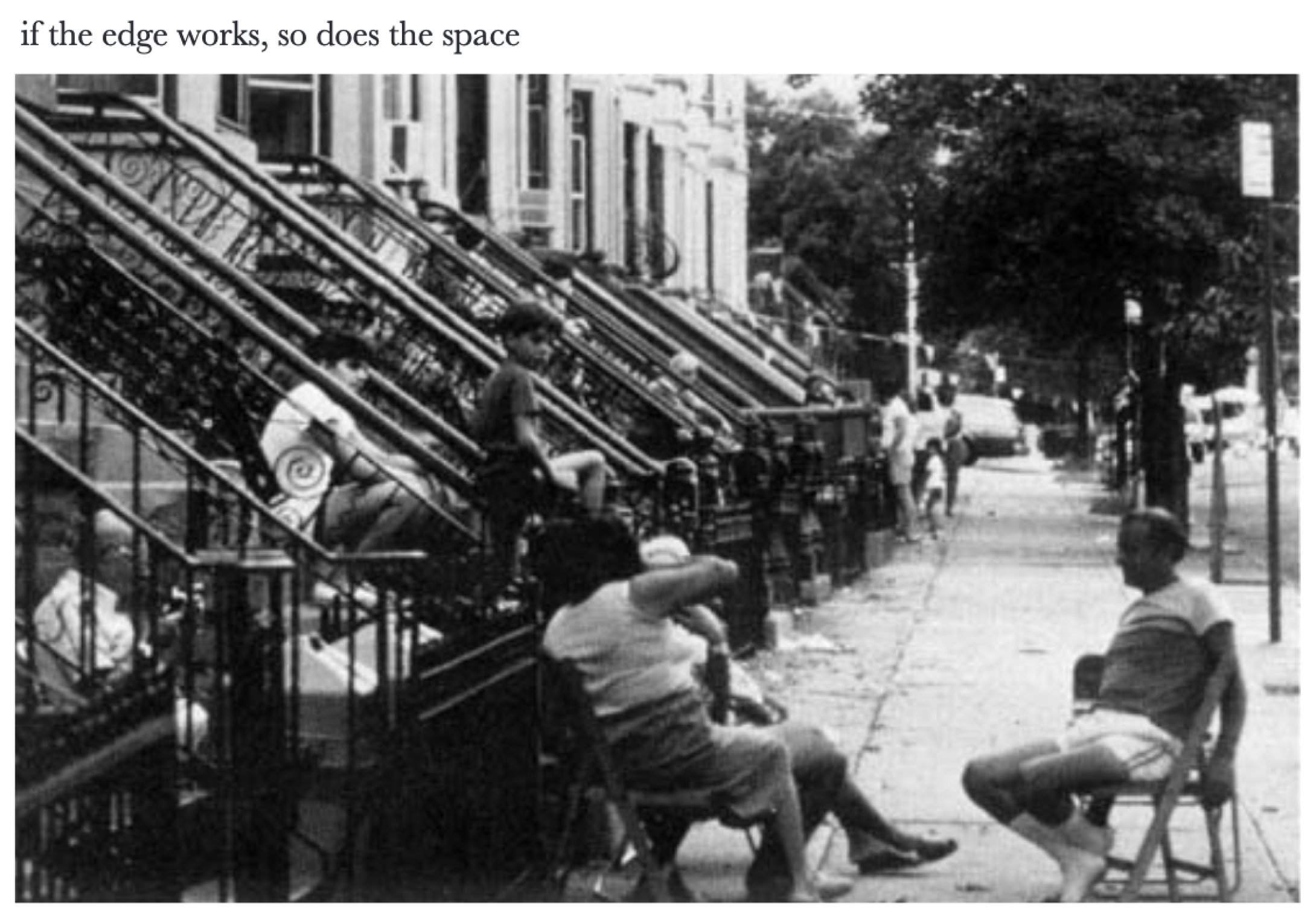
Pedestrian Plaza Visits & Edge Categorization
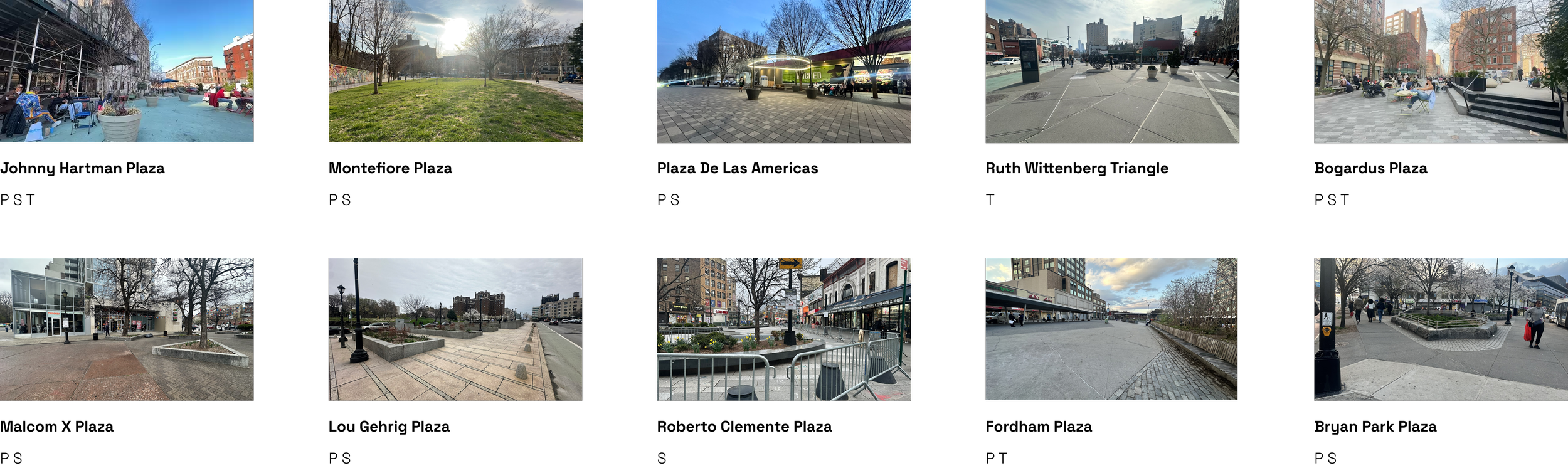
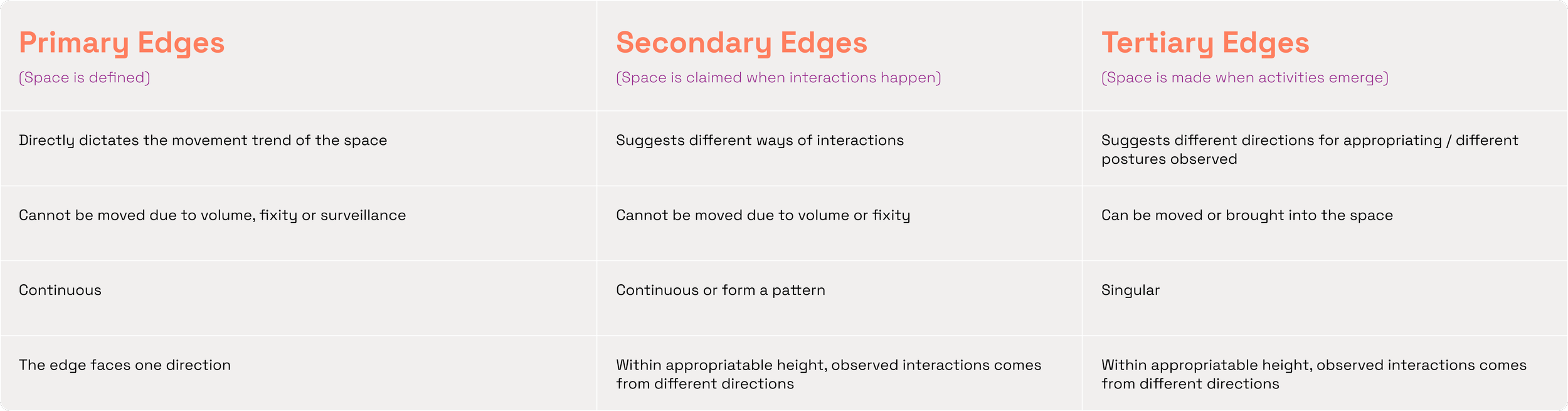
P/S/T Edge Typology
In a closer reading of Merleau-Ponty, in Phenomenology of Perception, he describes the body as held in a permanent oscillation between
&
"an attraction to the richness" of the world
"anxious warning against getting lost or absolved" in the same richness.
It lives in this unity.
What the body needs to live is not pure closure nor pure openness, but a structure that holds the two in productive relation.
So, Are Secondary/Tertiary Edges Better?
Different edges serve different functions in urban open spaces. The task is to identify the type of situated needs an edge condition mediates.
“These walls functioned much like cell membranes, both porous and resistant.
That dual quality of the membrane is, I believe, an important principle for visualizing more modern living urban forms. Whenever we construct a barrier, we have to equally make the barrier porous; the distinction between inside and outside has to be breachable, if not ambiguous.”
Richard Sennett, “The Open City”
Non-moveable-chair Triangle
Ruth Wittenburg Plaza
Local Plaza Partner
Plaza Size
Plaza Geometry
Village Alliance BID
3550 SF
Triangle
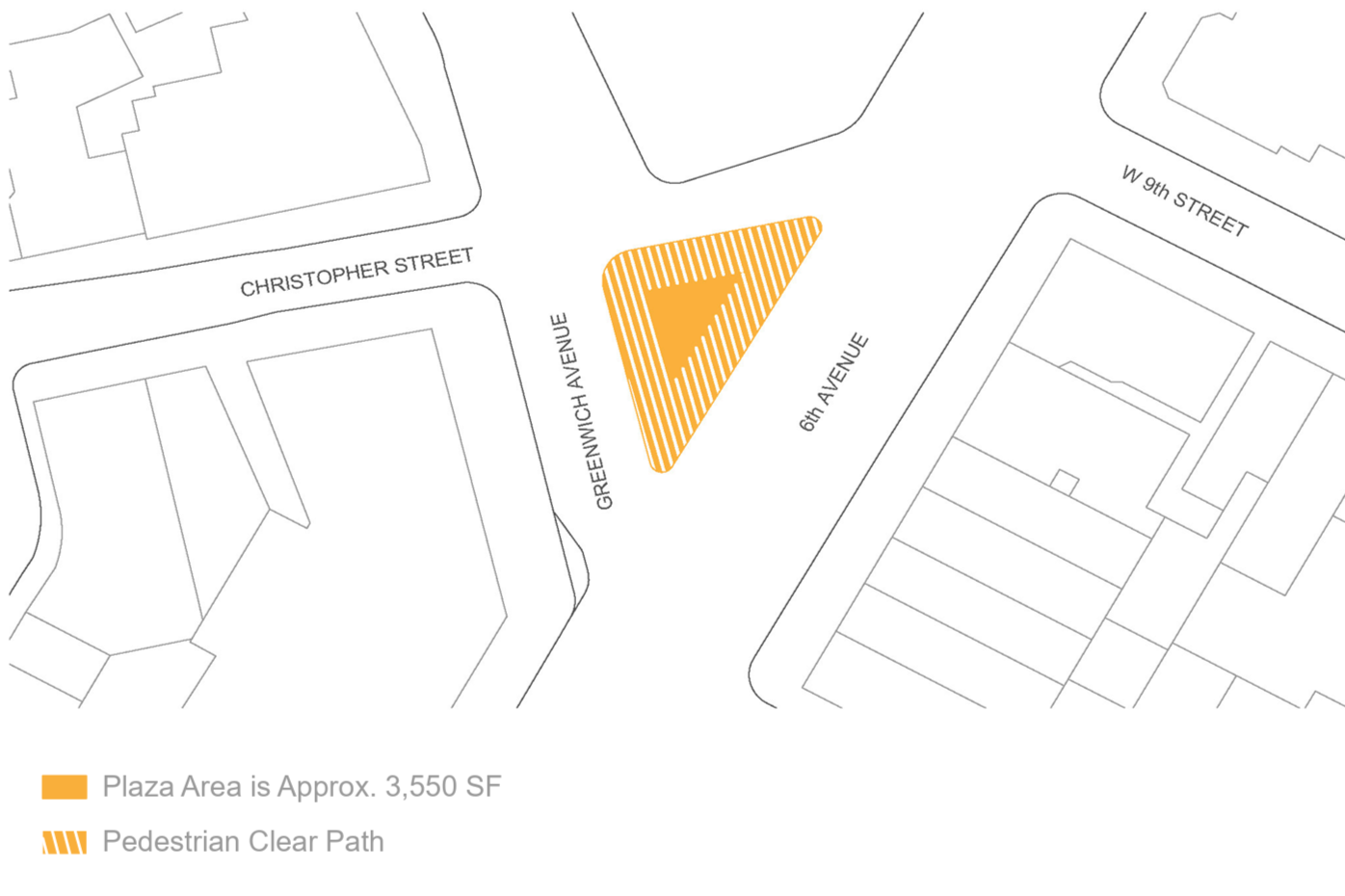
Ruth Wittenberg Plaza sits at a median in the intersection of three streets carrying very high pedestrian traffic: 944 passings counted in the thirty-minute window. The furnishing strategy is movable chairs and tables, the DOT catalog's standard solution. On the day of the observation, the chairs and tables were stacked and locked at the edge of the plaza, not put out for use at all. The staying count during my visit was one: a man sitting on the stack of chairs by himself. The plaza is a small floating median, with traffic on every side and no wall, no ledge, no facade to mediate the flow or put a body against. People do not tend to hang out on an island they had to cross into and where every side faces a moving lane. Movable chairs, in Whyte's New York observations, were the canonical solution for plazas that already had built edges to work against. The DOT catalog inherits the prescription without inheriting the condition that made it work.
What Ruth Wittenberg surfaces is that the kind of edge a plaza needs is not separable from the kind of street it sits on. NYC's Pedestrian Mobility Plan classifies city streets into five corridor categories by pedestrian volume and destination density. A plaza on a low-traffic Baseline Street is doing different work than a plaza on a high-density intersection. Ruth Wittenberg sits in one of the densest pedestrian environments in the city. A small median, saturated at this volume, cannot host a tertiary layer that has nothing to nest on. It needs edges that mediate movement first.
Roberto Clemente Plaza
Local Plaza Partner
Plaza Size
Plaza Geometry
Third Avenue BID
17750 SF
Triangle
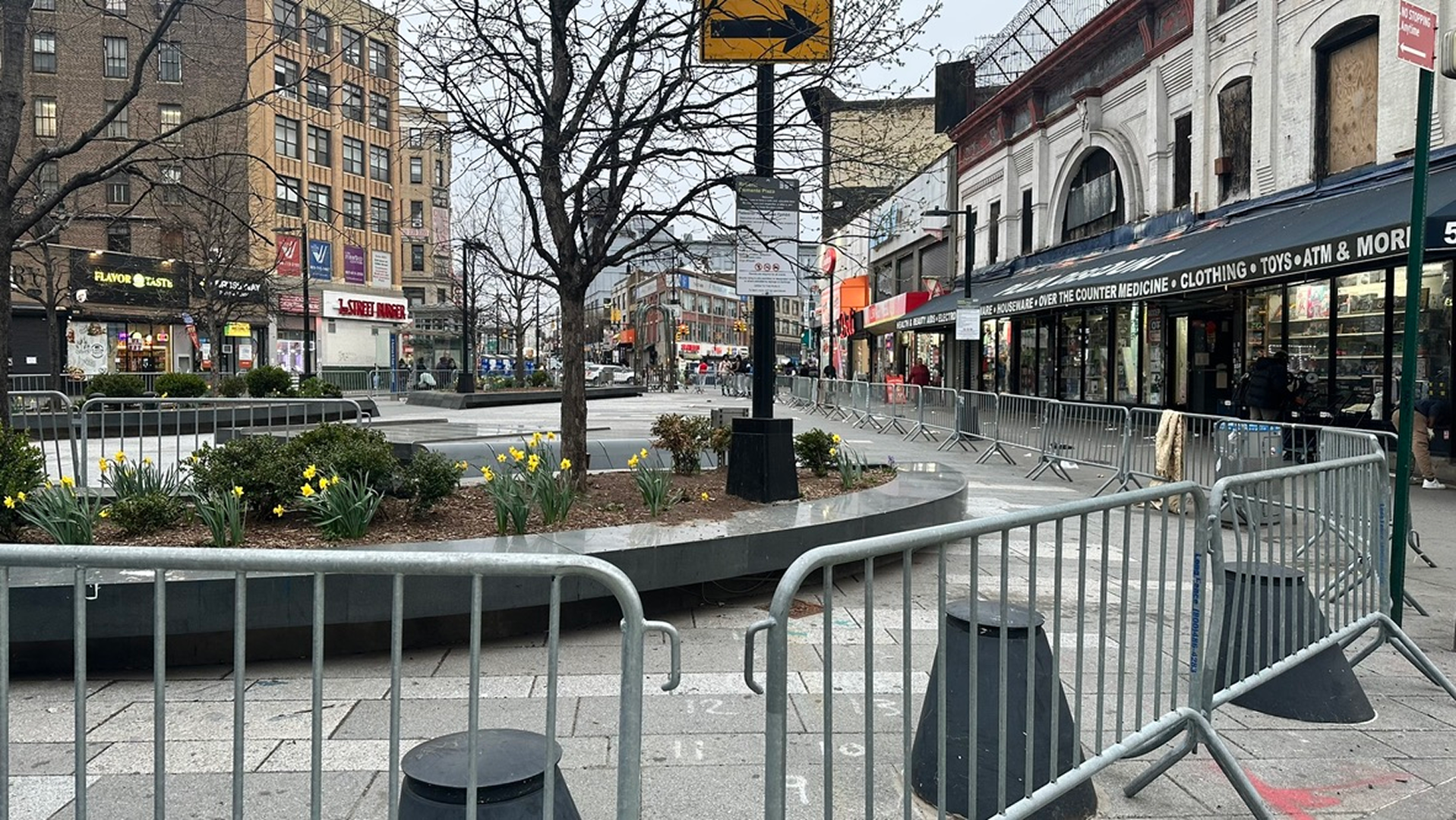
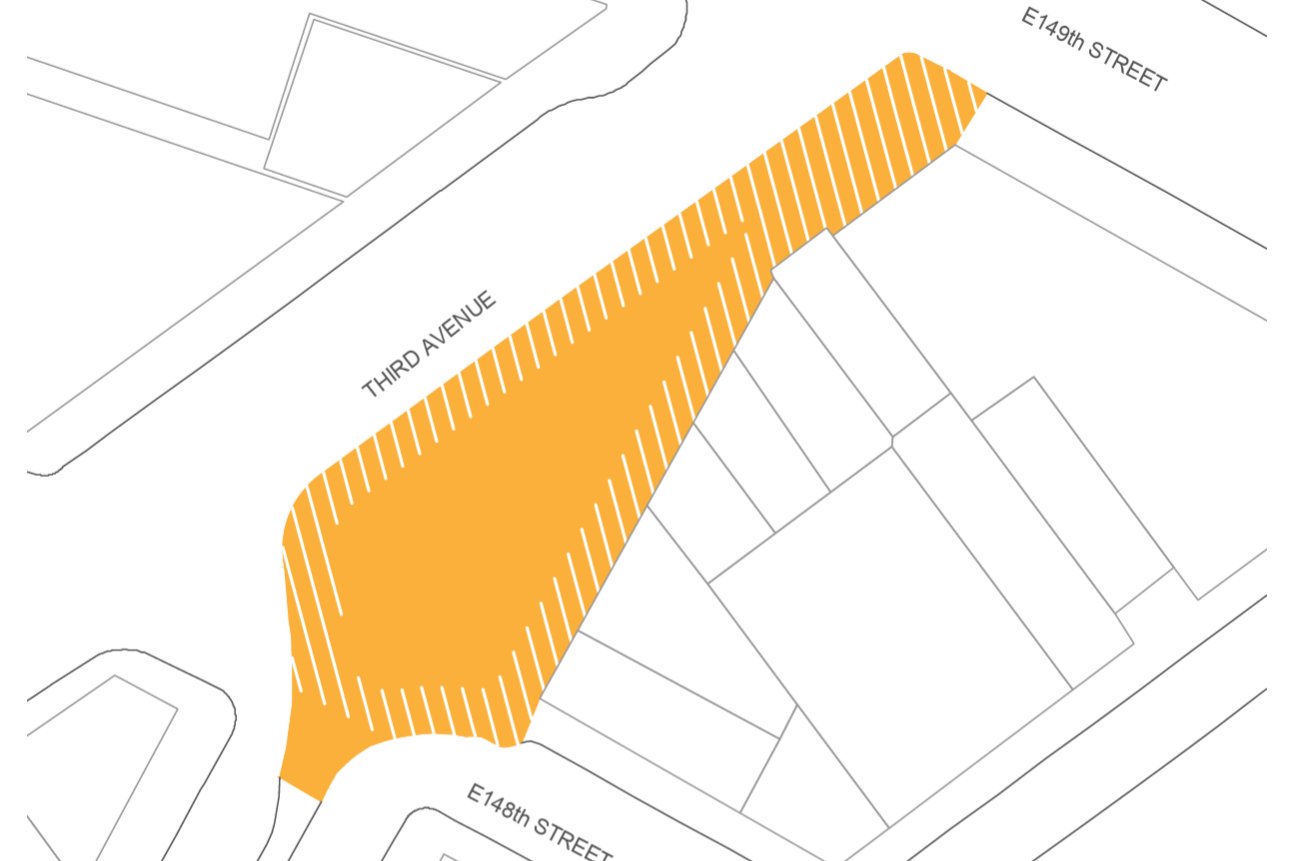
Roberto Clemente Plaza, in the South Bronx, partnered with the Third Avenue BID, complicates the question further. The plaza serves a working-class neighborhood with high demonstrated need for public space. It sits at the heart of a commercial district known locally as The Hub, where 149th Street meets Willis, Third, and Melrose Avenues, with the Bx41 bus stop running alongside the plaza's edge. Opened in 2018, the 17,750-square-foot triangle handles approximately seventy-five thousand passing pedestrians a day. The plaza's interior, on inspection, contained the most continuous and well-intentioned secondary seating of any plaza in the corpus, a long ribbon of bench surfaces with no hostile spikes, no dividing armrests, the kind of generous sittable edge Whyte and Gehl would have endorsed without qualification.
On the observation day, the plaza was fenced off. The NYPD had installed metal barricades around the plaza's seating area in July 2025, after years of escalating drug activity in The Hub. The fence is not the typological move this project would have recommended; it is a blunt, temporary apparatus, carceral in form, that names the problem more than it answers it. The interesting reading is what the five-of-five passing residents interviewed during the field visit said about it. Each one, unprompted, reported relief that the plaza had finally been closed. They had lost the seating, but they had regained the route.
The plaza had been absorbing a public-space failure too large for it. What the residents were saying, in the vocabulary they had to hand, was that what was needed first was to restore the route, the legible passing-through, the basic predictability of being able to cross the corner without being cursed at. By being relieved at the plaza's conversion into a continuous primary edge, they were articulating a typological judgment the literature does not yet have language for: that a large expanse of open secondary surface was not the function this neighborhood, at this moment, was able to host. They were not endorsing the fence. They were endorsing the edge change the fence had, by default, performed.
Through spring 2026, the plaza began to reopen on a different schedule. A Bad Bunny lookalike contest in March drew over a hundred spectators and twenty-eight contestants from as far as Brooklyn and New Jersey; a Summer Pop-Up Concert Series followed, with Puerto Rican music, African and Caribbean cultural performances, a book exchange with Community Board 1, kids activities, and local vendors. The barricades remained, but the programming brought the local public into the space, which the open plaza had not been able to safely host. Amaurys Grullon of Bronx Native framed the underlying conviction directly: "We have an open space. Why are we not utilizing it?" Pedro Suarez of the Third Avenue BID proposed "a permanent low-rise fence with strict operating hours that the BID can help manage," and that the plaza "only be used for scheduled, coordinated public events." Both, from different positions, described an edge that performs a different function than the current one.
Roberto Clemente was being asked to do edge-work at two scales at once. The physical: a plaza of this size and typology, a small triangle adjacent to a subway entrance at one of the densest pedestrian convergences in the borough, is itself an edge in the city's larger fabric. It mediates four converging avenues and eight directions of approach, the subway underground and the street above, the South Bronx residential blocks, and The Hub's corridor of transit, vending, and commerce. The plaza, in other words, is doing edge-work at the scale of the city before it does any edge-work for the bodies inside it. The social: the plaza was being asked to mediate the publics, the surrounding city had stopped mediating elsewhere. A neighborhood whose public-space provision the city had let lapse will, of course, deposit its unmet needs onto whatever space remains. The drug activity that concentrated at the plaza was not local to the plaza. It was the symptom of a public-space failure across the borough that arrived at the only remaining surface to land on. The fence is the city's blunt response. The programming is the stewards' more attentive one. Neither, on its own, dissolves the structural condition that produced the overload.
The question now is how the plaza grows back its social infrastructure. Could a tertiary layer — movable chairs, vending presence, small objects users bring with them — begin to do the maintenance work? Could a combination of primary and tertiary edges hold staying and passing at once? A plaza that can offer only one edge typology, statically, is a plaza that will fail in one direction or another, depending on what the surrounding city is asking it to absorb.
The Fenced Hub
What Ruth Wittenberg and Roberto Clemente both surface is that the edges inside a plaza cannot be read apart from what the plaza is, in its city, an edge to.
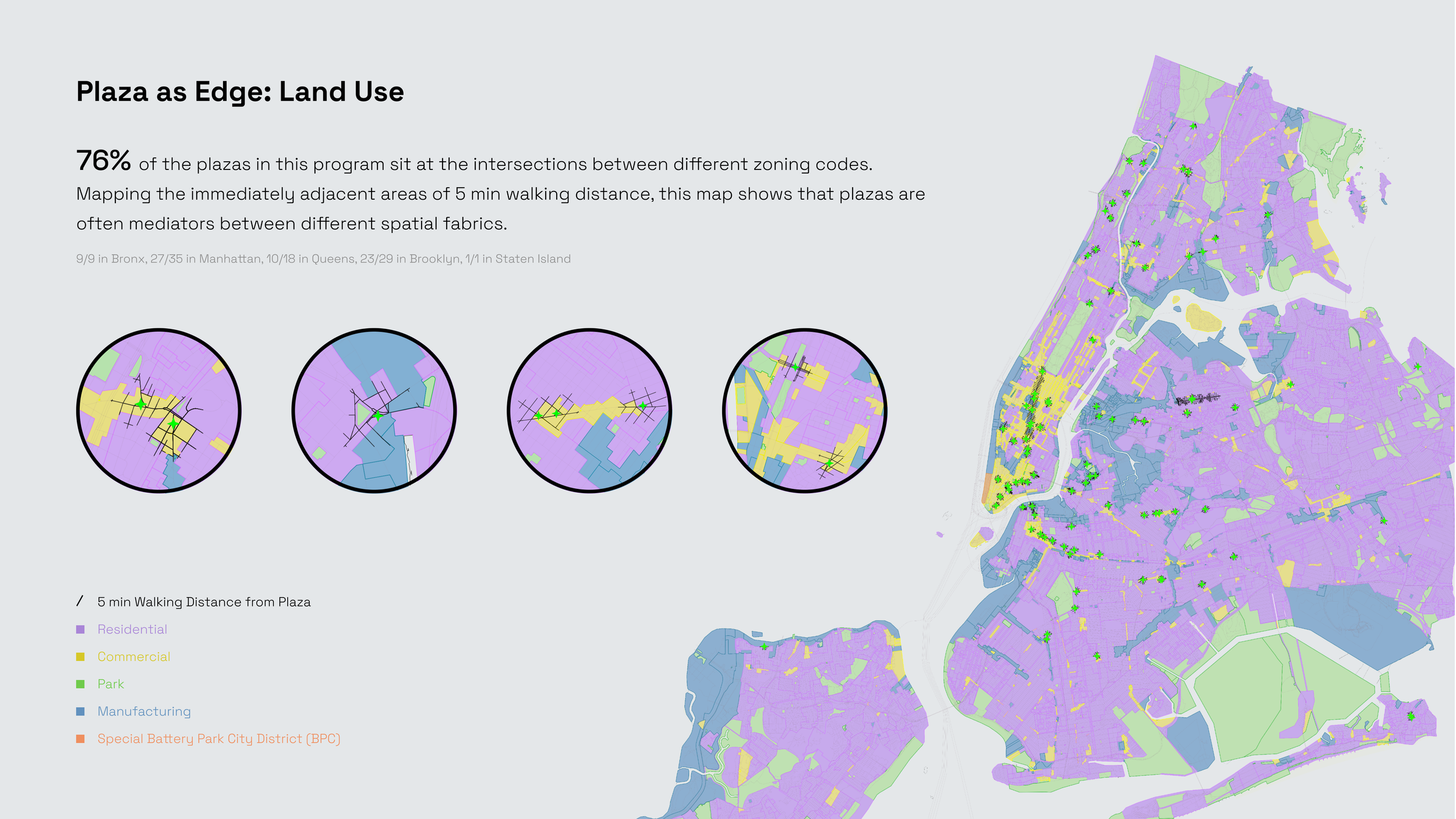
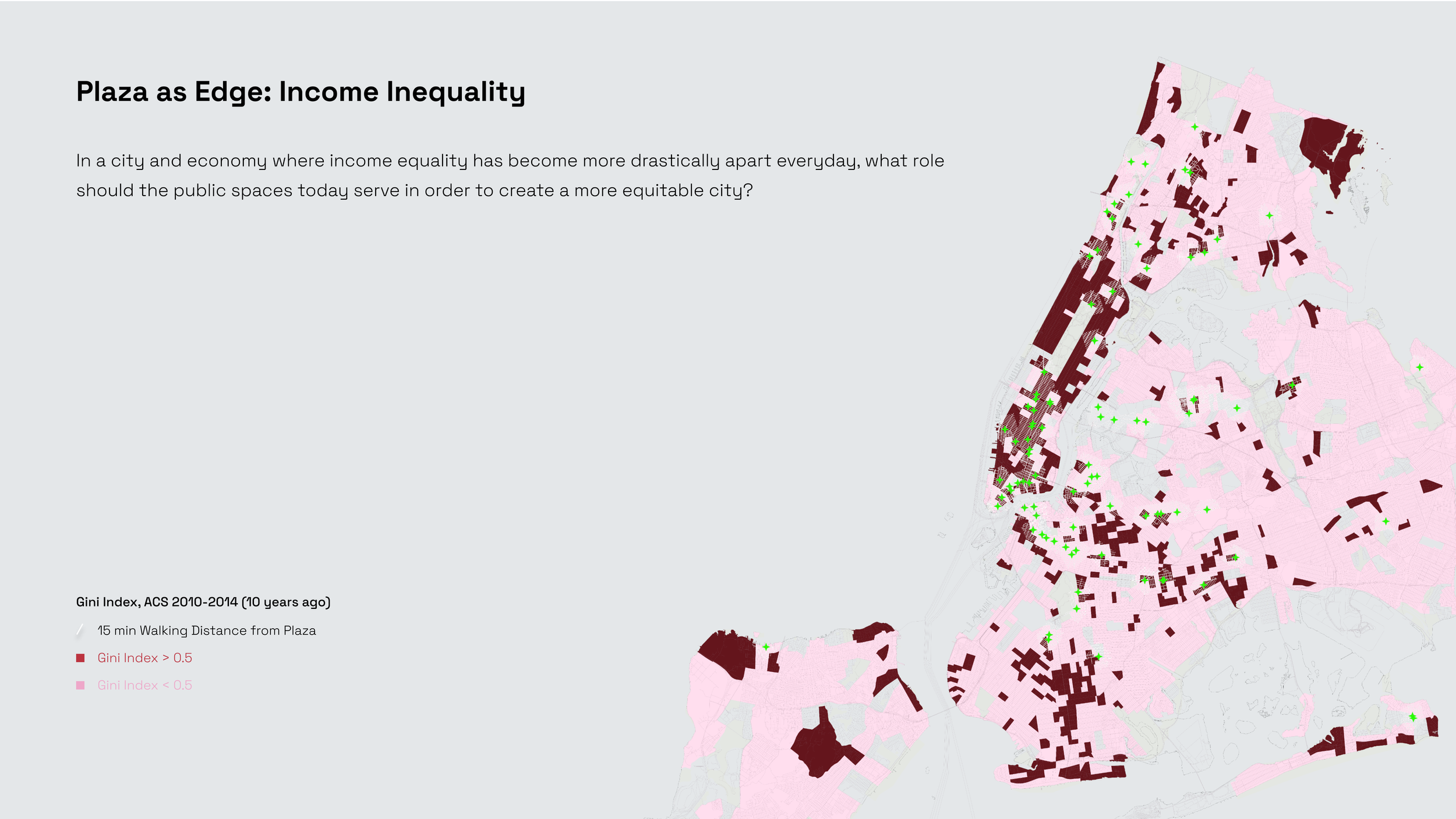
The maps that follow read this scale.
Plaza as Edges